

PQQ tends to get sold as a breakthrough or waved away as hype. The human studies sit somewhere in between, and the details tell a more useful story than either camp.
Short answer: A small set of human trials, most using 20 mg of PQQ a day for 8 to 12 weeks, have looked at sleep, fatigue, memory, attention, inflammation markers and muscle function. The most consistent signal so far is in memory and attention, from a few small placebo-controlled trials. The sleep, fatigue and inflammation findings come from very small or uncontrolled studies. Promising, early, and worth reading closely.
The back story of how PQQ was found is told in the story behind PQQ, and the cell biology behind the interest sits in why midlife energy starts in the cells. Most of that work happened in dishes and animals. This article stays with people: who took part, how much they took, what changed and how much weight each result can carry.
Sample size and design come first here. Headlines come second.
What has been studied in people?
Fewer trials than the marketing suggests. The human research on PQQ is a handful of studies, mostly from Japan, mostly short, and mostly small. Several were funded by companies that make PQQ, which is common in ingredient research and worth knowing.
Design matters as much as the result. An open-label study gives everyone the ingredient and compares before with after, so expectation and the passing of time can drive the change. A randomised, double-blind, placebo-controlled trial splits people into two groups, gives one a dummy capsule, and keeps everyone unaware of who got what. That second design carries far more weight, even at the same sample size.
Here is how the main studies line up, outcome by outcome.
What happened to sleep and fatigue?
The best-known sleep study gave 17 adults 20 mg of PQQ a day for eight weeks. There was no placebo group and no blinding. By the end, participants reported less fatigue, more vigour, and better scores on two standard sleep questionnaires covering sleep onset, sleep duration and how rested they felt on waking. The researchers also tracked the morning cortisol rise and found it moved in step with the questionnaire changes. (Nakano et al., 2012)
It is an encouraging starting point, and it is also the weakest design on this list. Seventeen people, self-reported outcomes and no comparison group means the result could reflect expectation as easily as the ingredient.
Evidence grade: early. One small open-label study. A placebo-controlled sleep trial is the obvious next step, and it has yet to be published at any real size.
What about attention and memory?
This is where the human evidence is strongest, relatively speaking.
In a randomised, double-blind, placebo-controlled trial, 41 healthy older adults took 20 mg of PQQ a day or a placebo for 12 weeks. On a standard selective-attention test, the PQQ group showed a smaller shift in interference scores than the placebo group, which the authors read as better-preserved attention. On a visual-spatial test, improvement showed only in the subgroup that started with lower scores, an after-the-fact split that needs confirming. (Itoh et al., 2016)
A larger double-blind trial randomised 70 healthy adults aged 20 to 65 to 20 mg of PQQ a day or a placebo for 12 weeks, with 62 included in the final analysis. Across the whole group, composite memory and verbal memory improved compared with placebo. The gains in memory showed up in the over-40 group, while the under-40 group improved on cognitive flexibility and processing speed. Most of the other cognitive domains measured showed no difference. The trial was fully funded by a PQQ manufacturer. (Food & Function trial, 2023)
A 2024 trial in 34 older adults with mild cognitive impairment tested PQQ combined with molecular hydrogen for six weeks. Some brain measures moved, though the main blood marker showed no significant difference between groups, and the mixed product means the effect cannot be pinned on PQQ alone. (Baltic et al., 2024)
Evidence grade: moderate but early. A few small, mostly industry-funded placebo-controlled trials pointing in the same direction on specific memory and attention measures.
What about inflammation markers?
One study, ten people. Five men and five women took PQQ in a fruit drink in two short crossover phases, dosed by body weight. After the daily phase, blood levels of two inflammation markers, C-reactive protein and interleukin-6, fell, and urine metabolites shifted in a pattern the researchers linked to mitochondrial activity. Standard blood chemistry, including cholesterol and glucose, stayed normal and unchanged. (Harris et al., 2013)
It was a careful piece of lab work, built to see what PQQ does in the human body over a few days. It was never designed to show a health outcome.
Evidence grade: very early. Interesting biology, tiny sample, days long.
And muscle strength?
The newest addition. In a 2024 randomised, double-blind, placebo-controlled trial, 64 healthy Japanese adults with an average age in their mid-50s took 21.5 mg of PQQ disodium salt a day or a placebo for 12 weeks; 62 completed it. The PQQ group improved on leg extension strength, grip strength and three walking tests compared with placebo, and no adverse events were reported. (Shiojima et al., 2024)
Evidence grade: promising, single trial. A clean design and a relevant age group. It now needs an independent repeat.
How much PQQ did the studies use?
Almost every trial above used about 20 mg a day, taken for 8 to 12 weeks. The one exception, the inflammation study, dosed by body weight over a few days.
The 20 mg figure also anchors the safety picture. The European Food Safety Authority assessed PQQ disodium salt as a novel food and concluded it is safe for healthy adults at up to 20 mg a day in food supplements, excluding pregnant and breastfeeding women. The panel also noted that data on how PQQ is absorbed and processed in the body remain limited. (EFSA, 2017)
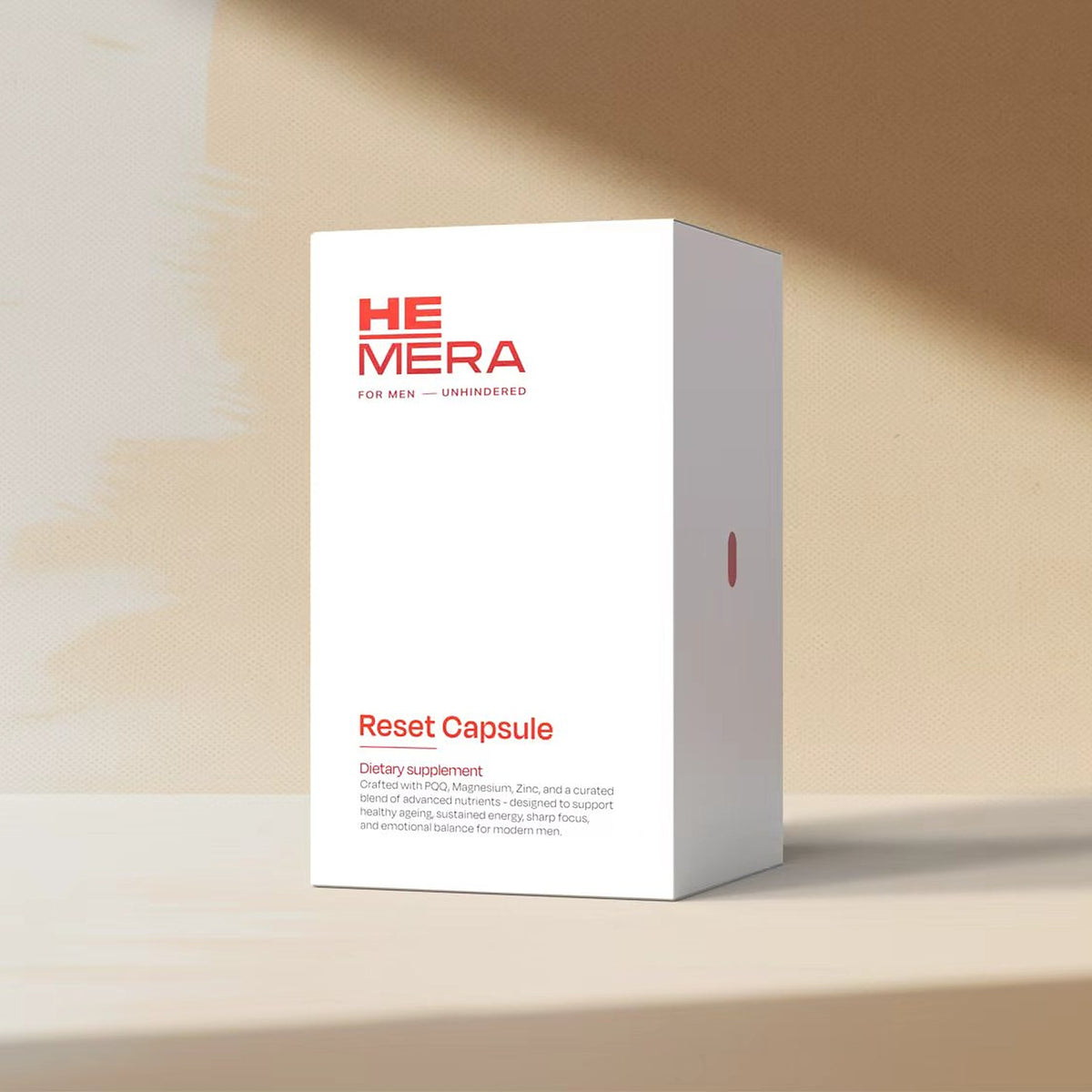
That is why Reset Capsule carries 20 mg of PQQ per capsule, and the full reasoning sits in Reset Capsule explained. To be clear about scope: every study here tested PQQ as a single ingredient. None of them tested the finished Reset formula.
What is still unknown?
Quite a lot, and it is worth saying plainly.
- Size. The largest trials have 60 to 70 people. Results this small can shift once bigger groups are tested.
- Independence. Much of the work is funded by PQQ makers. Independent replication would add real weight.
- Duration. Twelve weeks is the longest typical trial. Long-term effects in healthy people are unstudied.
- Who benefits most. Age, baseline scores and lifestyle all seem to shape results, and the patterns are still unclear.
- Sleep under blinded conditions. The sleep and fatigue signal still rests on one open-label study.
Each gap is a reason to read the findings with care, and to watch for the next round of trials.
Common questions
Is there good human evidence for PQQ?
There is early human evidence. A few small placebo-controlled trials show improvements in specific memory, attention and muscle measures, while sleep and inflammation findings come from smaller or uncontrolled studies.
How much PQQ was used in human trials?
Most trials used about 20 mg a day for 8 to 12 weeks. EFSA assessed 20 mg a day as safe for healthy adults, excluding pregnant and breastfeeding women.
Does PQQ help with sleep?
One open-label study of 17 adults reported better sleep scores and less fatigue after eight weeks. Without a placebo group, that result is a starting point, and firm conclusions would need controlled trials.
Were these studies done on Reset Capsule?
No. Every study described here tested PQQ on its own. They are single-ingredient research, separate from trials of any finished formula.
The takeaway
- Human research on PQQ is real, small and mostly short, with trials of roughly 10 to 70 people over days to 12 weeks.
- The most consistent signal is in specific memory and attention measures, from a few placebo-controlled trials.
- Sleep and fatigue results rest on one open-label study; inflammation findings on a ten-person study.
- A 2024 placebo-controlled trial added a muscle strength signal in adults in their 50s that now needs repeating.
- About 20 mg a day is the amount most studied and the level EFSA assessed as safe for healthy adults.
- Reset Capsule carries 20 mg of PQQ per capsule alongside B vitamins, magnesium and zinc; the full formula is on the Reset Capsule page.
Reset Capsule is a dietary supplement. It is not intended to diagnose, treat, cure or prevent any condition.